


Find the materials and services you need.
Find an office, plant, quarry, or store location near you.
Trusted for safely delivering high-quality custom work.
Our 5 Fundamentals: Safety, Quality, Custom Solutions, Sustainability & Long-Term Relationships

-
 Safety
From the office to the job site and every roadway in between, there’s nothing more important than everyone returning home safely.
-
 Quality
Quality is an outcome only achieved by investing in the right people, materials, training, technology, and equipment. imi consistently delivers superior quality on every project.
-
Custom Solutions
Throughout all divisions of imi, we customize a solution for every job. We create customer-specific ready mix concrete, asphalt mix designs, and soil-stabilization services.
-
Sustainability
imi proactively works to lower our embodied carbon footprint. We were early adopters of solutions like CarbonCure and choose materials that reduce transport and waste.
-
Long-Term Relationships
For nearly 100 years, imi has focused on building long-term relationships with customers and industry partners. By providing expertise and delivering high-quality custom work, our relationships have stood the test of time.


Learn More about the Company History
Materials & Services
Concrete
Building Materials
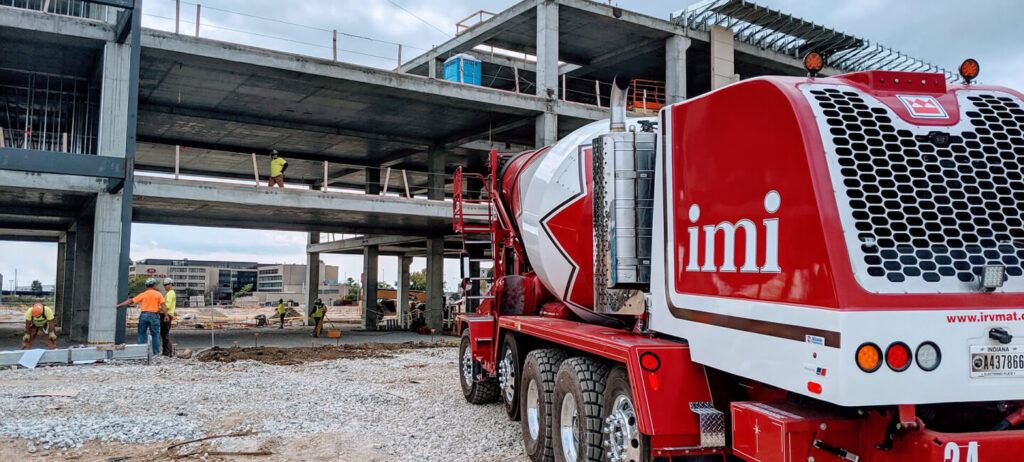
imi has ready-mix concrete locations throughout Indiana, Kentucky, Ohio, and Tennessee. All imi and Kuert Concrete plants offer highly customizable mix designs for everything from foundations to roadways, curbs, bridges, tunnels, and beyond.
LEARN MORECrushed Stone, Sand, Gravel & Aglime
Building Materials
imi mines and produces crushed stone, sand, and gravel throughout Indiana. We also produce high calcium and dolomitic agricultural lime.
LEARN MOREAsphalt Paving, Concrete Paving & Bridge Construction
Construction Services
E&B Paving is imi’s construction division that specializes in bridge, highway, and road construction.
LEARN MORESoil Stabilization, Fence & Guardrail
Construction Services
Specialties Company is a construction division of imi that specializes in subbase and site preparation work. They operate throughout the United States and provide the crews, equipment, and expertise needed to stabilize the ground to control erosion and improve load bearing capacities.
LEARN MORETools, Bagged Materials & Sealants
Materials & Supplies
imi Supply serves as a one-stop shop for construction tools, supplies, and materials. With locations throughout Indiana, Kentucky, Ohio, and Tennessee, there is a team ready to help you find timely, cost-effective solutions.
LEARN MOREFeatured Projects
Ultium Cells Electric Vehicle Battery Plant
Nucor Steel Gallatin
MacAllister Machinery
Finch Creek Fieldhouse
Interstate 65


Save time with paperless ticketing using the industry leading Material Now app
Material Now has improved the concrete delivery process end-to-end for 2 million+ digital tickets. Submit an order from your phone or tablet, check the status of your job in real-time, and e-Sign your tickets all from the app.
Download the app to get started.


Employees are our greatest asset
We build more than bridges, buildings, and roads. We build leaders, teams, and communities. Apply today to build your bright future with imi.
View Career Opportunities